
If you've ever looked at a page of harakat in Arabic and noticed small marks above and below the letters, you've already met the harakat. But what is a harakat, exactly? In simple terms, harakat meaning refers to "movements" — the short vowel signs that tell a reader how to pronounce each letter. Without them, Arabic script only shows consonants and long vowels. The reader has to rely on memory and context for everything else.
This is exactly why arabic harakat matter so much for beginners. A new reader can't yet guess missing vowels the way a fluent speaker can. Unvocalized text becomes a guessing game. Add harakat back in, and every word becomes readable letter by letter. That's why the Quran, children's Arabic books, and most learning materials all use arabic with harakat. It removes ambiguity. It lets a student sound out words correctly from day one.
The difference between plain script and vocalized text is simple. It's the difference between "I think I know what this says" and "I know exactly what this says." For Quranic recitation, that precision isn't optional — it's essential. Mispronouncing a single vowel can change a word's entire meaning. This guide walks you through every core harakat and related marks like Sukun and Tanween. We'll also answer a question students ask constantly: What is harakat_at_tawheed?
What is Arabic Harakat (Short Vowels)
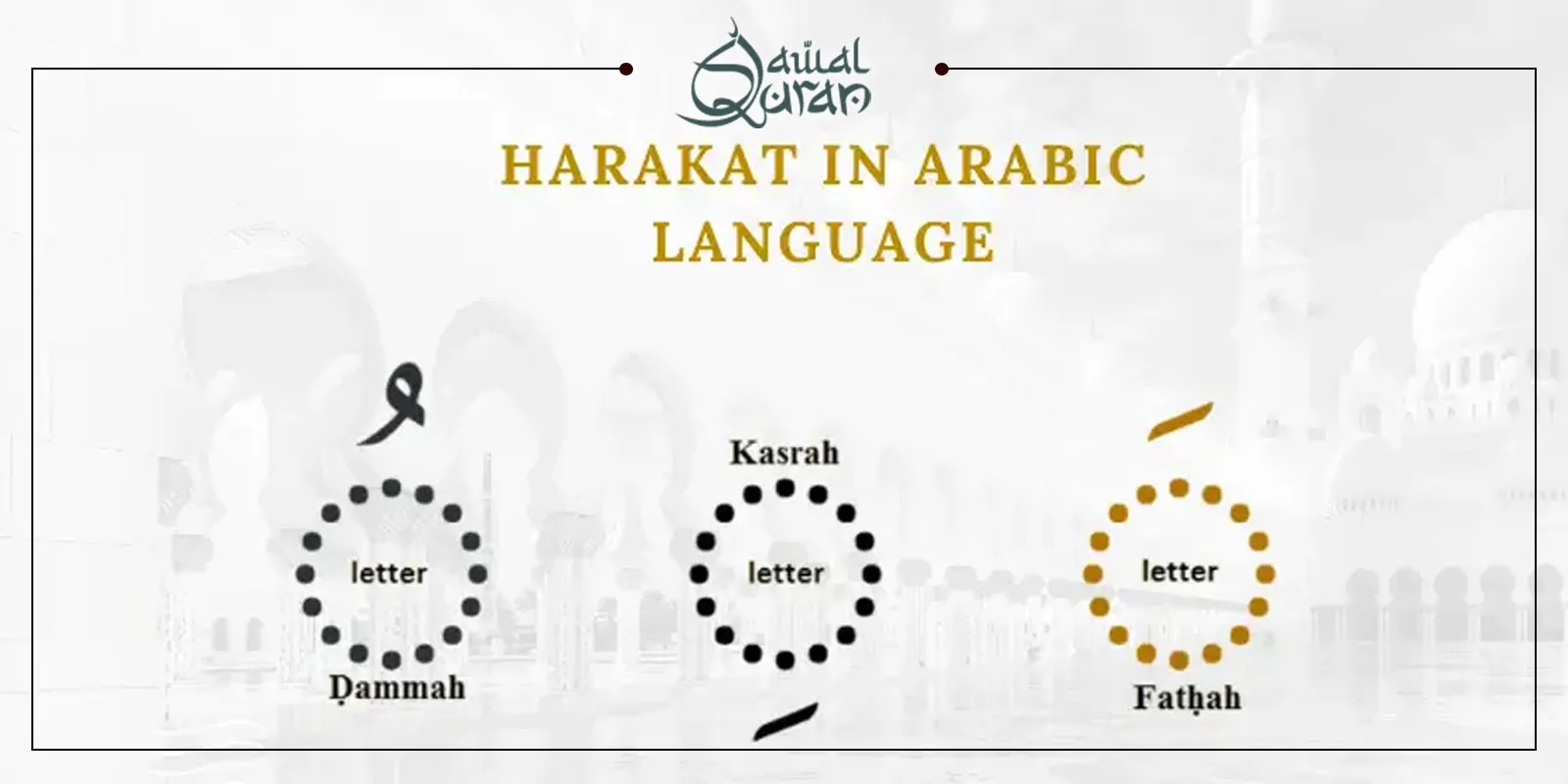
There are three basic harakat in arabic. Every fluent reader eventually pronounces them by instinct. Here's what each one does:
Fatha ( َ ) — A small diagonal stroke above a letter, producing a short "a" sound, similar to the "a" in "cat." The mouth opens slightly. The sound stays short and light — never stretched.
Damma ( ُ ) — A small curl above the letter, producing a short "u" sound, like the "u" in "put." Your lips round slightly forward, and you release the sound quickly.
Kasra ( ِ ) — A short diagonal stroke below the letter, producing a short "i" sound, like the "i" in "sit." The jaw drops just slightly. The sound stays low and brief.
One common point of confusion for beginners is 2 harakat vs. 1 harakat. A single harakat lasts one count — a quick vowel sound. A madd letter (a long alif, waw, or ya) can extend that vowel. When it does, the vowel becomes long and lasts two counts. We call this 2 harakat. This timing forms the foundation of correct Quranic rhythm. New reciters get it wrong more often than almost anything else.
Essential Marks: Sukun & Tanween
Beyond the three core vowels, Arabic uses a few more marks that every learner needs to recognize.
Sukun ( ْ ) marks a letter that carries no vowel at all. You pronounce it as a pure consonant sound, with nothing following it. Shadda ( ّ ) signals a doubled letter. You pronounce it with emphasis, merging two identical consonant sounds into one stressed sound.
Tanween refers to doubled harakat that sit at the end of a word — double fatha, double damma, or double kasra. They add an "n" sound to the pronunciation, such as "-an," "-un," or "-in." You'll see this often in nouns and adjectives, and it follows specific grammatical rules.

What is harakat_at_tawheed?
So, whats harf tawkeed, and how does it connect to harakat? Harf tawkeed literally means "letter of emphasis." It refers to a small group of Arabic particles that stress or affirm a sentence's meaning. The most common ones are inna and anna ("indeed" / "that"). Related particles include lakinna, la'alla, and layta.
Harf tawkeed matters for a Tajweed student for one key reason: these particles don't just add emphasis in meaning — they change grammar too. When a harf tawkeed enters a sentence, it puts the following noun into the accusative case. That case directly affects which harakat arab the noun takes at its ending. Once you understand harf tawkeed, the "why" behind many harakat placements finally makes sense. It's rule-based, not random.
This topic looks small on paper. But it has a big impact on reading fluently and understanding harakat in Arabic sentence structure. That's exactly why it's worth learning alongside the basic harakat_at_tawheed, not after them.
Harakat in Tajweed: Precision in Quranic Recitation
In Tajweed, harakat aren't just pronunciation guides — they're rules of precision. A muffled Damma, a lazy Fatha, or a rushed Kasra can distort a word's intended sound. In Quranic recitation, that distortion matters. You need to pronounce every harakat clearly and completely. Let your mouth reach its full position before you move on.
There's also a deeper layer: vowel pitch and depth. The same harakat in arabic can sound noticeably different depending on the surrounding letters. A "heavy" letter (Tafkheem) pulls the vowel deeper and rounder. A "light" letter (Tarqeeq) keeps it thinner and clearer. Adjusting vowel depth this way ranks among the more advanced — but essential — skills in proper Tajweed.

Common Vowel Mistakes to Avoid
Even dedicated learners tend to fall into a few recurring traps:
- Stretching short vowels — accidentally turning a single-count harakat into a 2 harakat sound, often out of habit. This changes the rhythm and, in some cases, the meaning of the word.
- Clipping vowels — the opposite problem, where a short vowel is cut so short it almost disappears, making the letter sound like it has a Sukun when it doesn't.
Both mistakes are common. Both are correctable. That's exactly why structured, guided practice matters more than self-teaching from books alone.
Practical Tips to Master Harakat Arabic
The good news is that harakat_at_tawheed, while detailed, are very learnable with consistent practice:
- Read daily from fully vowelled text. Practicing with arabic with harakat every day trains your eyes and mouth together, building the muscle memory needed for fluent, accurate reading.
- Shadow-read with certified reciters. Listening to a qualified Quran reciter and repeating after them, phrase by phrase, helps you internalize the correct sound, pitch, and timing for every harakat — something text alone can't teach.
- Get feedback from a teacher. Self-study can only take you so far. A qualified instructor can catch subtle mistakes in real time — a stretched vowel, a dropped Sukun, an unclear Tafkheem — long before they become habits.
Conclusion
Understanding harakat — and knowing exactly what is harf tawkeed — is the first real step toward reading Arabic and the Quran with confidence and accuracy. From the three core vowels of Fatha, Damma, and Kasra, to the finer details of Sukun, Tanween, and grammar-shaping particles like harf tawkeed, every mark plays a role in how a word is meant to sound and read. But knowing the rules is only half the journey; real fluency comes from consistent, guided practice with a teacher who can correct you in real time.
If you're ready to move from understanding harakat in theory to reciting with true Tajweed precision, our Tajweed and Noorani Qaida Course is designed to take you there — step by step, with qualified instructors and a structured, beginner-friendly curriculum. Enroll today and start your journey toward confident, correct Quranic recitation.
Frequently Asked Questions
What is a harakat?
A harakat is a short vowel mark placed above or below an Arabic letter to show how it should be pronounced. Without harakat, a reader has to rely on memory and context to guess the correct vowel sounds — with them, every letter can be read exactly as intended.
What does harakat mean in Arabic?
The harakat meaning comes from the Arabic word for "movement." Each mark represents a small vocal movement — a short "a," "u," or "i" sound — that brings a silent letter to life when reading or reciting.
What is the difference between 1 harakat and 2 harakat?
A single harakat (like a Fatha, Damma, or Kasra) is a short vowel held for one count. When that vowel is extended with a madd letter, it becomes a long vowel held for two counts, known as 2 harakat. Getting this timing right is essential for correct Tajweed rhythm.
How long does Tajweed take?
Learning functional Tajweed takes 3 to 12 months of consistent practice, depending on your starting point and daily study habits.
Why is arabic with harakat important for beginners?
Reading arabic with harakat removes guesswork. Beginners haven't yet built the intuition that fluent speakers use to fill in missing vowels, so fully vocalized text lets them sound out every word accurately from the very start.
How to learn Tajweed easily?
Learning Tajweed easily starts with mastering the basic articulation points of Arabic letters step-by-step and practicing daily with a qualified teacher.
What is harf tawkeed and how is it connected to harakat arab rules?
Harf tawkeed refers to Arabic particles of emphasis, such as "inna" and "anna," used to stress or affirm a statement. When used, they change the grammatical case of the following noun, which in turn determines the harakat arab placed on that word's ending — connecting grammar directly to correct pronunciation.


