
Every act in Islamic prayer (Namaz/Salah) carries deep spiritual meaning — and the Tashahhud is no exception. For millions of Muslims around the world, the Tashahhud in Salat is one of the most sacred moments of the entire prayer. It is the point where a worshiper pauses, sits in humility, and directly addresses Allah and His Prophet ﷺ in a beautiful declaration of faith.
But many Muslims — especially new learners — often wonder: When exactly is the Tashahhud read? Why is it so important? And what does it actually mean?
This dua is also widely known as Attahiyat (or At-Tahiyyat) — a name that comes directly from its opening word. You may also see it spelled At Tahiyyat or At-Tahiyyatu in different transliterations; all refer to the exact same dua recited in Salah.
This article walks through everything one needs to know about the Tashahhud prayer — from its position in Salah, to its full text, transliteration, and the profound wisdom behind it.
What Is the Tashahhud?
The Tashahhud (also spelled Tashahud or Tashaud) is an Arabic supplication recited while sitting during the Islamic prayer. The word "Tashahhud" literally comes from the root word shahada, meaning "to bear witness." In essence, the Tashahhud dua is a declaration of testimony — bearing witness that there is no god but Allah and that Muhammad ﷺ is His messenger.
This dua is also widely known as Attahiyat in English — derived from its very first word, At-Tahiyyat, meaning "all salutations." The attahiyat meaning centers on offering greetings, blessings, and good deeds to Allah alone. You'll find the complete attahiyat translation in English further down this guide.
This sitting posture of reciting the Tashahhud in Salah is often referred to as the Qa'dah position. It is a deeply personal and spiritually charged moment in every unit of prayer.
When Is the Tashahhud Read in Namaz?
Understanding when to recite the Salat Tashahhud requires a basic understanding of the structure of Islamic prayer (Salah). The attahiyat dua in Salat is recited during the sitting position (Qa'dah) which occurs at specific points depending on the number of Rak'ahs (units) in each prayer.
The Middle Tashahhud (Tashahhud Awwal)
In prayers that consist of three or four Rak'ahs — such as Maghrib (3 units) or Zuhr, Asr, and Isha Namaz Rakat (4 units each) — the first Tashahhud is read after completing the second Rak'ah. The worshiper sits, recites the Tashahhud dua, and then stands to complete the remaining units. This sitting is called the At-Tashahhud Awwal or the "first sitting."

The Final Tashahhud (At-Tashahhud Al-Akhir)
The final Tashahhud is read at the very end of every prayer — after the last Rak'ah is completed. Whether it is a two-unit prayer like Fajr, a three-unit prayer like Maghrib, or a four-unit prayer like Isha, every prayer Tashahhud ends with this final sitting. After this, the worshiper sends blessings upon the Prophet ﷺ (Salawat/Durood Ibrahim) and then concludes the prayer with the Tasleem (saying Assalamu Alaikum Wa Rahmatullah to both sides).
The Full Tashahhud Dua — Text, Transliteration & Meaning in English
Attahiyat Full Dua — Tashahhud Transliteration
Below is the attahiyat full dua transliteration as narrated in authentic hadith (Ibn Mas'ud, reported in Sahih Bukhari and Muslim):
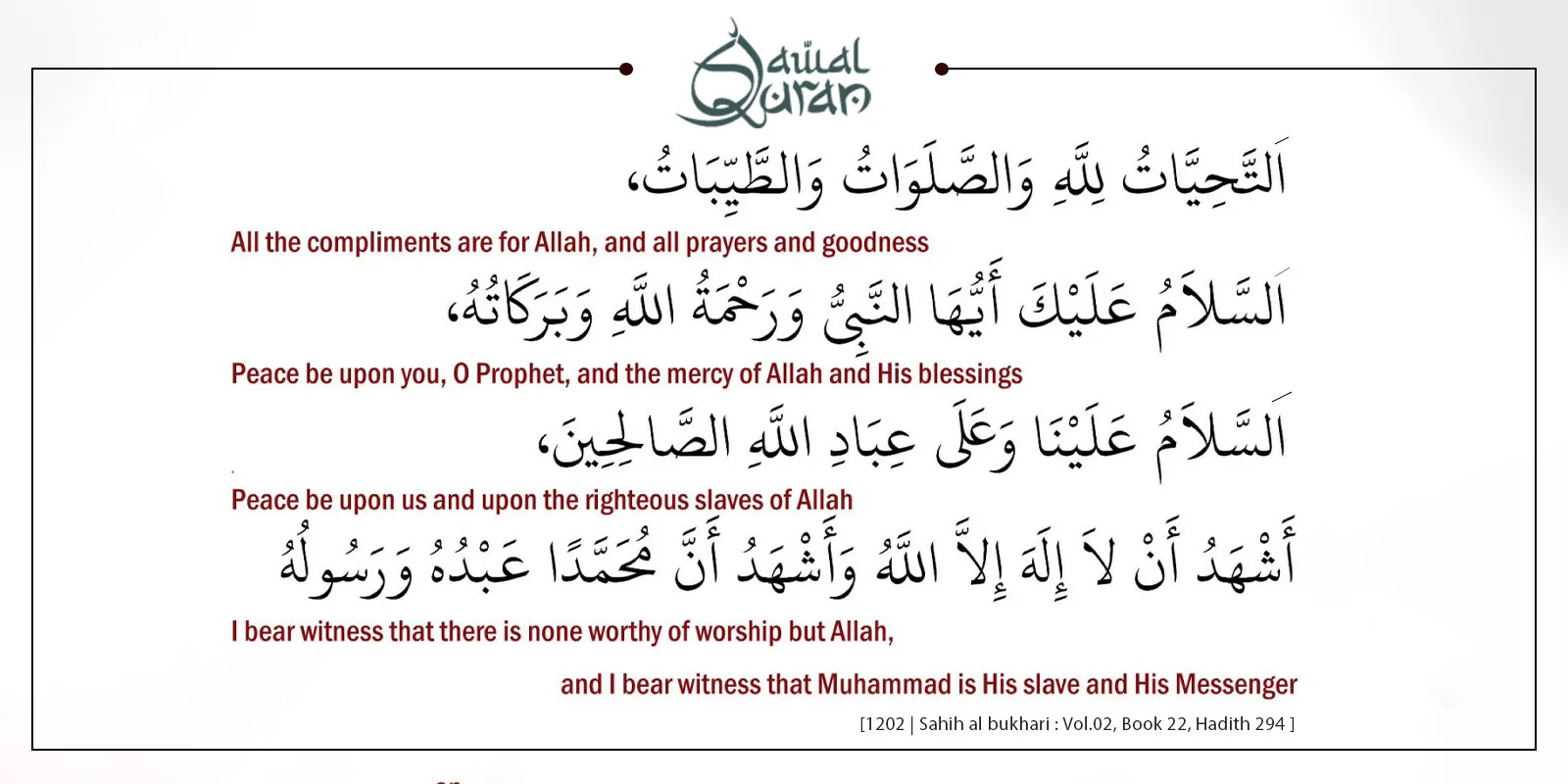
"At-Tahiyyatu lillahi was-salawatu wat-tayyibatu. As-salamu 'alayka ayyuhan-Nabiyyu wa rahmatullahi wa barakatuh. As-salamu 'alayna wa 'ala 'ibadillahis-salihin. Ash-hadu an la ilaha illallah wa ash-hadu anna Muhammadan 'abduhu wa rasuluh."
Tashahhud in English (Word-by-Word Meaning)
Tashahhud Meaning in English (Attahiyat Translation)
For those searching for the attahiyat meaning or attahiyat translation, here is the full English rendering:
"All greetings, blessings, and good acts are for Allah. Peace be upon you, O Prophet, and the mercy of Allah and His blessings. Peace be upon us and upon the righteous servants of Allah. I bear witness that there is no god worthy of worship except Allah, and I bear witness that Muhammad is His servant and His messenger."
This is also widely known as Attahiyat in English — derived from the very first word of the dua, At-Tahiyyat, meaning "all salutations."
Why do we say Tashahud Dua?
We say the Tashahhud in Islamic prayer (Salah) to reaffirm the oneness of God, honor the Prophet Muhammad, and renew our core statement of faith.
What does tashadud mean?
at tahiyyat dua means violence, oppression, or severity.
Dua After Tashahhud Before Salam
After reciting the final Tashahhud and Durood (Darood-e-Ibrahim) in the last sitting of the prayer, it is a recommended Sunnah to recite specific supplications (duas) seeking protection and forgiveness before giving the final Salam
Other authentic Masnoon duas include the supplication starting with "Allaahumma innee dhalamtu nafsee..." seeking forgiveness and mercy, as well as the short prayer asking Allah for help in remembering Him, thanking Him, and perfecting His worship. The full Arabic texts and translations for these supplications are available in the referenced sources.


Why Do Muslims Read the Tashahhud in Salah?
The Tashahhud in Salah is not merely a ritual recitation — it is a spiritually loaded moment that serves multiple purposes. Here's why it holds such a central place in tashaud prayer:
1. Renewing the Declaration of Faith
At its core, the Tashahud is a reaffirmation of the Shahada — the most fundamental pillar of Islam. Every time a Muslim reads the tashahud dua, they are actively renewing their covenant with Allah, declaring that He alone deserves worship and that the Prophet Muhammad ﷺ is His final messenger.
2. Sending Salutations Upon the Prophet ﷺ
The tashahud in Salat includes direct salutations upon the Prophet ﷺ: "As-salamu 'alayka ayyuhan-Nabiyyu" — meaning "Peace be upon you, O Prophet." This is a unique and intimate act of love and connection with the Prophet ﷺ that occurs within the salat Tashahhud itself.

3. A Moment of Direct Communication with Allah
According to a narration, the tashahud was taught to the companions as the words exchanged between Allah and His Prophet ﷺ during the Mi'raj (the Night Journey). This gives the prayer Tashahhud an extraordinary spiritual dimension — as though the worshiper is joining a divine conversation.
4. Expressing Gratitude and Submission
The opening words of Attahiyat in English — "All greetings, blessings, and good acts are for Allah" — express complete submission and gratitude. By reading the Tashahhud, the worshiper acknowledges that every blessing in life belongs to Allah alone.
5. Connecting the Individual to the Ummah
The phrase "Peace be upon us and upon the righteous servants of Allah" within the Tashahhud in Salah connects each worshiper to the entire community of believers — past, present, and future. It is an act of communal solidarity embedded within personal prayer.
The Spiritual Significance of the Sitting Position
The posture in which one recites the Tashahhod prayer — sitting with the right index finger raised — also carries meaning. Raising the index finger during the Tashahhud in Salat symbolizes the declaration of Tawheed (the oneness of Allah). It is a physical gesture that mirrors the verbal testimony being made.
Some scholars describe this posture as resembling the stance of someone who has just completed a journey and is now reporting back to their Creator — humble, focused, and wholly present.
Common Questions About the Tashahhud
Is the Tashahhud obligatory or Sunnah?
Scholars hold some difference of opinion on this matter. The Hanafi school of thought treats the final Tashahud (At-Tashahhud Al-Akhir) as obligatory (Wajib), while the Shafi'i school elevates it to a pillar (Rukn) of the prayer — meaning a worshiper cannot complete a valid prayer without it. Regarding the middle Tashahhud, Hanafi scholars rule it as Wajib (obligatory), whereas scholars from other schools treat it as Sunnah.
What happens if someone forgets the Tashahhud?
If a worshiper forgets the middle Tashahhud in Salat, they must perform the Sujood as-Sahw (prostration of forgetfulness) at the end of the prayer. Forgetting the final Tashahhud dua has more serious consequences depending on the madhab (school of thought) one follows.
Is there more than one version of the Tashahhud?
Yes. The companions of the Prophet ﷺ narrated multiple versions of the Tashahud , including those from Ibn Mas'ud, Ibn Abbas, and Umar ibn al-Khattab. Scholars in the Hanafi and Hanbali traditions most widely follow the version narrated by Ibn Mas'ud.
Tips for Memorizing the Tashahhud
For those who are new to learning the Tashahhud transliteration, here are some practical tips:
- Break it into sections: Divide the Tashahhud dua into three or four short segments and memorize each one before combining them.
- Understand the meaning: Learning the Tashahhud in English word by word makes it far easier to memorize and recite with focus.
-Practice during prayer: Even when learning, practice reciting the prayer Tashahhud silently within actual prayers to build the habit.
- Listen to audio recitations: Hearing the correct pronunciation of the Tashahhud transliteration from a qualified reciter helps internalize the proper rhythm and sounds.
Conclusion
The Tashahhud is far more than a routine recitation slotted into the structure of Salat. It is a deeply meaningful moment of testimony, gratitude, connection, and love — read at least twice in every Salah, and serving as the spiritual centerpiece of Islamic prayer. Whether one is reciting the Tashahhud dua in the middle of a four-unit prayer or finishing the final sitting of Fajr, each recitation is an opportunity to renew faith and draw closer to Allah.
Understanding when and why Muslims read the Tashahhud in Salah transforms it from a memorized formula into a living, breathing act of worship. And that, after all, is the true spirit of every prayer.
FAQ's
What is the Tashahhud in Salat and why do Muslims read it?
The Tashahhud in Salat is a sacred dua where a worshiper declares faith in Allah and sends salutations upon the Prophet ﷺ. Muslims read it to renew their Shahada and express complete submission to Allah during every prayer.
What is the full Attahiyat dua?
The full Attahiyat dua (also called Tashahhud) begins with "At-Tahiyyatu lillahi was-salawatu wat-tayyibatu" and continues through the testimony of faith: "Ash-hadu an la ilaha illallah wa ash-hadu anna Muhammadan abduhu wa rasuluh." It is recited while sitting during Salah, once after the second Rak'ah in three or four-unit prayers, and again at the end of every prayer.
What does Attahiyat Lillahi mean?
Attahiyat Lillahi" is the opening phrase of the Tashahhud dua, meaning "All greetings and salutations are for Allah." It expresses that every act of worship, honor, and blessing belongs to Allah alone, setting the tone for the rest of the dua.
When do Muslims recite the Tashahhud in Salah?
Muslims recite the Tashahhud in Salah during the sitting position after the second Rak'ah in three and four-unit prayers, and again at the very end of every Salat. Every prayer — whether Fajr, Maghrib, or Isha — ends with the final Tashahhud before Tasleem.
What does the Tashahhud dua mean in English?
The Tashahhud dua in English translates as a greeting to Allah, a salutation upon the Prophet ﷺ, and a testimony that no one deserves worship except Allah and that Muhammad ﷺ is His messenger. It is also widely known as Attahiyat in English among learners of Islamic prayer.
What is the correct Tashahhud transliteration for beginners?
The Tashahhud transliteration begins with "At-Tahiyyatu lillahi was-salawatu wat-tayyibatu" and ends with the declaration "Ash-hadu an la ilaha illallah wa ash-hadu anna Muhammadan abduhu wa rasuluh." Beginners can break this Tashahhud prayer into three short parts to memorize it more easily.
Is the Tashahhud prayer the same across all schools of Islamic thought?
The core Tashahhud in Salat stays the same, but minor wording differences exist across schools based on different companion narrations. The version from Ibn Mas'ud is the most widely used in the Hanafi tradition, while other schools may follow slightly different wordings of the Tashahud.